Ray Pawlett • September 15, 2026


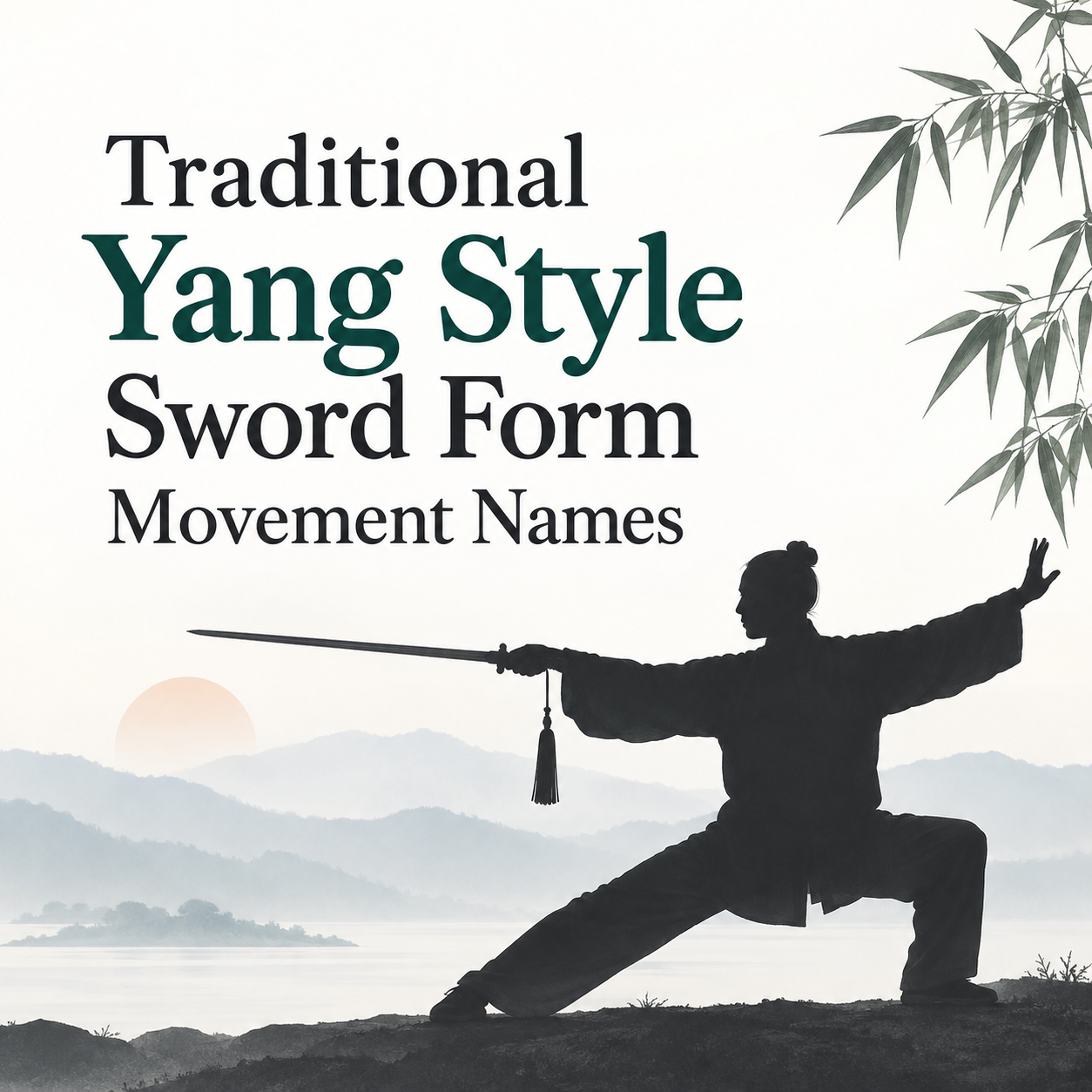
Traditional Yang Style Sword Form
Movement Names

English movement names only
Based on the teaching of Chris Pei
Compiled for Ki-Ways

1. Ready Posture

2. Opening

3. Secure the Moon with Three Rings

4. Big Dipper

5. Swallow Swoops Over the Water

6. Right Block

7. Left Block

8. Little Dipper

9. Swallow Returns to the Nest

10. Cat Seizes the Rat with Agility

11. Phoenix Picks Up Its Head

12. Wasp Enters the Cave

13. Phoenix Opens Its Right Wing

14. Little Dipper

15. Phoenix Opens Its Left Wing

16. Casting the Fishing Rod

17. Poking the Grass to Seek the Snake (Right)

18. Poking the Grass to Seek the Snake (Left)

19. Poking the Grass to Seek the Snake (Right)

20. Embracing the Moon

21. Birds Lodging in the Forest

22. Black Dragon Sways Its Tail

23. Green Dragon Gets Out of the Water

24. Lotus Swirls Around in the Wind

25. Lion Shakes Its Head (Left)

26. Lion Shakes Its Head (Right)

27. Tiger Covers Its Head

28. Mustang Jumps Over the Ravine

29. Reining the Horse

30. Compass Pointing South

31. Dusting in the Wind (Left)

32. Dusting in the Wind (Right)

33. Dusting in the Wind (Left)

34. Pushing the Canoe with the Current

35. Comet Chasing the Moon

36. Heavenly Steed Brings Good News

37. Lifting Up the Curtain

38. Car Wheel (Left)

39. Car Wheel (Right)

40. Swallow Carries Bits of Earth in Its Beak

41. Roc Extends Its Wings

42. Fishing for the Moon at the Sea Bottom

43. Naza Explores the Sea

44. Rhino Watches the Moon

45. Hunting the Wild Goose

46. Green Dragon Shows Its Claws

47. Phoenix Opens Both Wings

48. Step Over and Block Up (Left)

49. Step Over and Block Up (Right)

50. Hunting the Wild Goose

51. White Ape Presents Fruits

52. Falling Flowers (Right)

53. Falling Flowers (Left)

54. Falling Flowers (Right)

55. Falling Flowers (Left)

56. Falling Flowers (Right)

57. Fair Lady Works at Shuttles

58. White Tiger Sways Its Tail

59. Tiger Covers Its Head

60. Fish Jumps Over the Dragon's Gate

61. Black Dragon Twists Around the Pole (Left)

62. Black Dragon Twists Around the Pole (Right)

63. Fairy Points the Way

64. An Incense for Heaven

65. Plum Flower Is Swept by the Wind

66. Presenting the Tablet

67. Returning the Sword to Its Original Position


By Ray Pawlett September 7, 2026
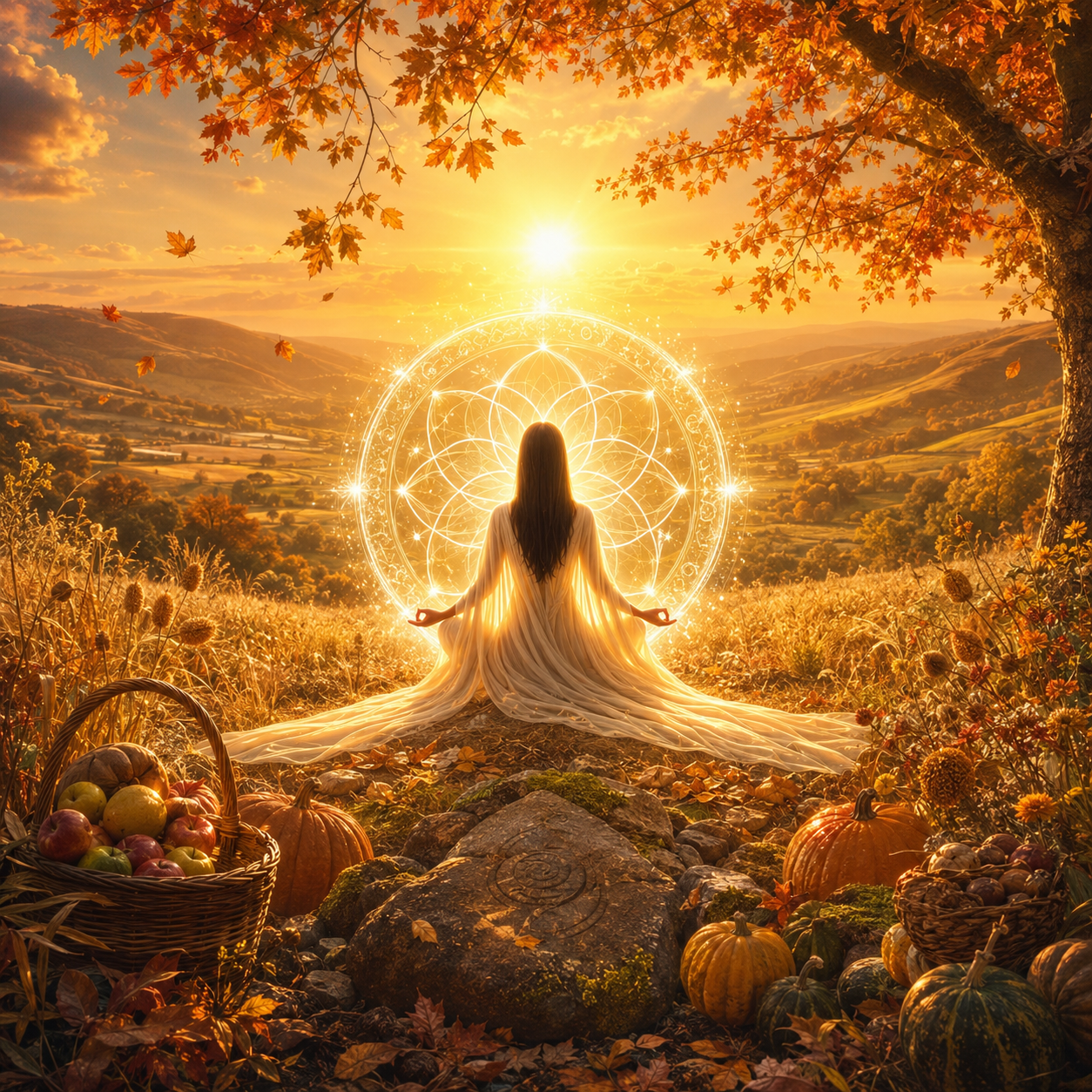
There is something about the arrival of autumn that invites us to slow down. The heady days of summer have given way to a gentler season. The days are becoming shorter, the evenings draw in, and nature begins to turn its attention towards the harvest. We must say goodbye to the summer! But perhaps we don't need to see that as something sad. Autumn has its own beauty, and its own invitation. It is a time of gathering, of giving thanks, and of preparing for the months ahead. The Harvest and Earth Energy Throughout the world, we have harvest festivals, ranging from the Chinese Moon Festival and the Pagan Lammas festival to the traditional Western Harvest Festival. The common theme throughout is to give thanks for what has been provided and to share it with our friends. And perhaps this is where the harvest connects most beautifully with Earth Energy. In traditional oriental medicine, early autumn is represented by Earth Energy. The organs related to Earth Energy are the stomach (yang) and the spleen (yin). Earth Energy is about the relatedness we have with other people. It is the compassion we feel for those around us – the wish to care for them, feed them, and help them feel safe. Think about the feeling of coming home after a long day. Perhaps someone has made you a cup of tea, or you sit down to a meal that has been prepared with care. There is something deeply reassuring about being fed, supported and welcomed. This is something of the quality of Earth Energy. If your Earth Energy is strong and settled, you will be able to create a feeling of serenity akin to an autumn sunset. You will feel supported, and you will be able to nurture others. When that sense of support is missing, we may find ourselves worrying, looking for reassurance, or feeling that we have to hold everything together ourselves. We may feel “ungrounded”. Worry and insecurity are balanced by compassion and loving kindness. The harvest reminds us that we do not have to provide everything for ourselves. We are part of a much larger web of life, and we are supported by the Earth, by nature, and by one another. Nature is constantly adapting But being supported does not mean that everything around us remains unchanged. Nature is constantly responding to the conditions around it, and we are part of that same living world. 2026 has been an interesting year in this respect. We have experienced some very warm weather in the UK, and it has been interesting to see how nature has responded. Farmers have had to bring some crops in early, and many of us have noticed changes in the timing of the seasons. Many older people will tell you that the seasons have changed since their childhood. The timing of nature’s harvest can shift, and the familiar signs of autumn may arrive earlier or later than we expect. But the Earth itself has not changed its place in the solar system. The seasons are still governed by the Earth’s orbit around the Sun and the tilt of its axis. What changes is the way the weather and the living world respond to those conditions. If we look at nature, we can see that it is constantly responding to its environment. Plants and animals change their cycles, and they find ways of adjusting to the conditions around them. This does not mean that nature always finds it easy. Sometimes changes in the weather can be stressful, and the living world can be affected in ways that are not helpful. But there is something for us to learn from that responsiveness. Finding our own balance Humans do not always have quite so much freedom to change and adapt. We get into patterns and routines that help us cope with our day-to-day lives. We have work, responsibilities, and commitments, and it is not always easy to change our plans when the world around us changes. It is easy to become disconnected from the world around us. We can get so caught up in our own routines that we stop noticing the seasons, the weather, and the subtle changes in nature. Perhaps this is where Earth Energy has something to teach us. Being grounded does not necessarily mean standing still. It can mean being settled enough to respond to what is happening around us. It can mean knowing when to hold on, and when to let go. It can mean allowing ourselves to receive support, rather than feeling that we must always provide everything for ourselves. And it can mean remembering that we are part of a much larger web of life. Going with the flow of nature Ancient wisdom gives us many tools to help us adapt. Meditation, healing, qigong, and simply taking notice of the world around us can all help. They give us an opportunity to pause, to reconnect, and to become a little more aware of what is happening both within us and around us. So, as we move into autumn, perhaps we can take a little time to notice the changing season. To appreciate what has been provided. To recognise the support that is already around us. And to ask ourselves: Where in my life am I being asked to adapt? Where might I be able to let go of an old pattern, rather than trying to make the world fit around it? Perhaps, like nature, we can learn to respond to the changing conditions with a little more flexibility, a little more compassion, and a little more trust. And perhaps that is one of the gifts of autumn. If you would like to explore these ideas further, we will be spending the morning together at our Autumn Equinox Meditation and Energy Session , taking time to reconnect with the Earth, with nature, and with ourselves. ๐Ÿ‚ Monday 14th September, 9:30am–12:30pm £30 Through meditation, gentle energy work, and shared intention, we’ll create a calm and supportive space to reconnect, restore balance, and leave feeling clearer, lighter, and re-energised.
By Ray Pawlett September 26, 2025
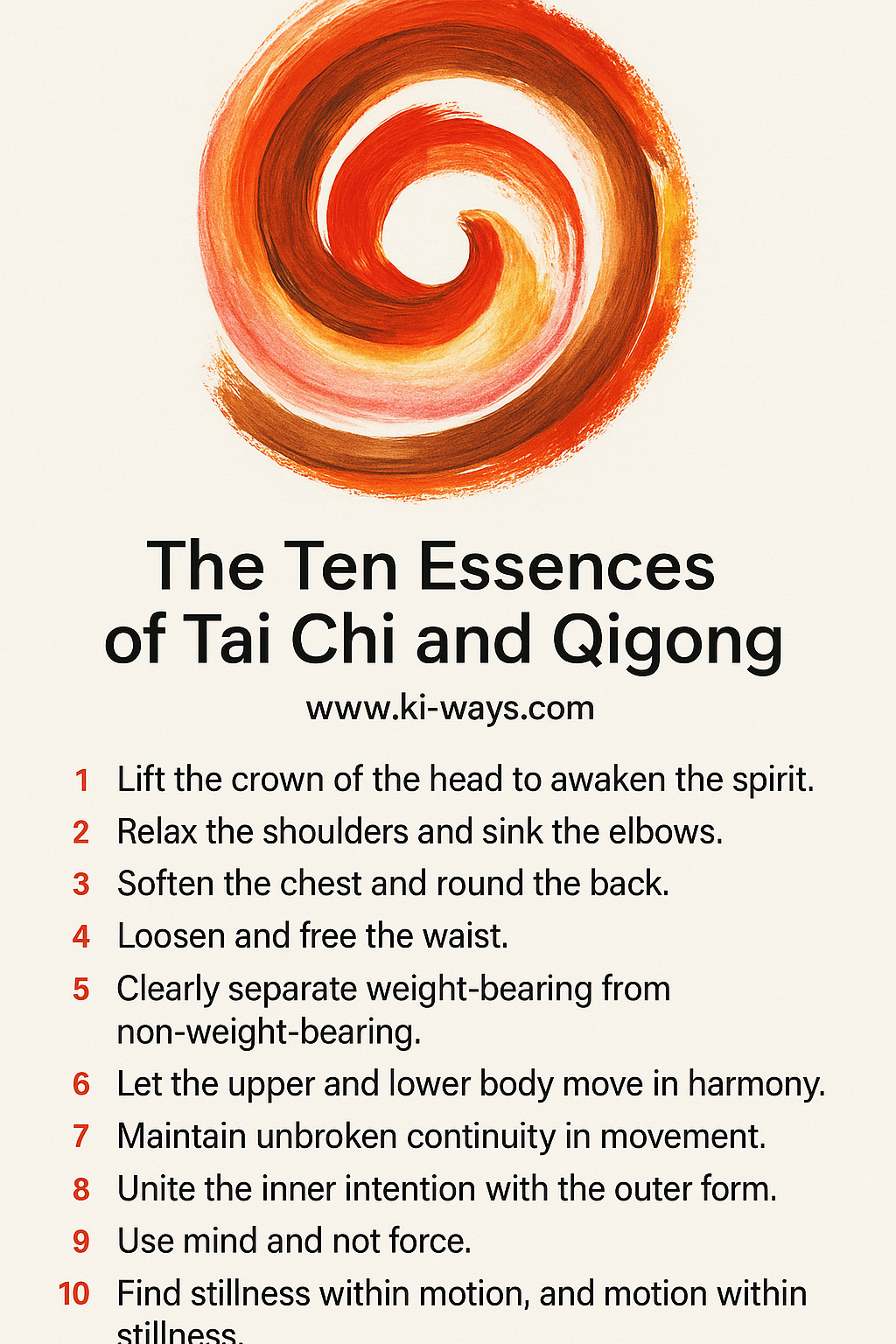
The Ten Essences
By Ray Pawlett December 5, 2024
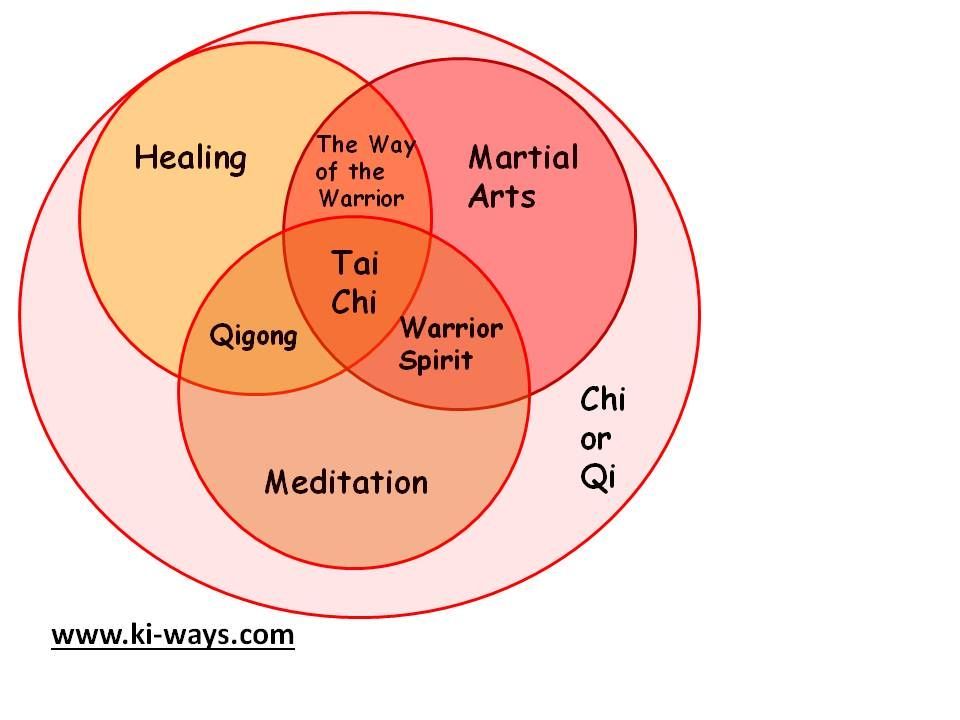
It is not uncommon to see people practicing Tai Chi - or to give it the full name Tai Chi Chuan. Usually their movements look graceful and sometimes powerful but unless you have tried Tai Chi, it looks at least a little bit weird. What are they doing? They look happy enough but what are they actually up to? I believe that this question should be a friend to the serious Tai Chi player. What are you doing? If you already practice, then think about that for a moment. If you keep a notebook for your Tai Chi, why not spend a few minutes writing down what you are hoping to achieve with your practice. If you have not had a go at Tai Chi yet, just have a think about it. What are these people doing? Don't worry about getting the answer wrong - it's not possible. Your practice is what you define it to be. Not anybody else's definition. If, though, you can introduce some clarity into what you are trying to achieve with Tai Chi, you are a lot more likely to get there. After you have had a think, take a look at this diagram. In it, I am giving a few ideas of what Tai Chi can mean for you and perhaps help you to focus more on what you want to get out of it. It is not definitive and other people have different ways of understanding Tai Chi. Have a think and see where it gets you.
Show More